Is Alliance Credibility Interdependent?
Joshua Alley and Brian Blankenship. Forthcoming. “Is Alliance Credibility Interdependent?” Political Science Research and Methods. https://doi.org/10.1017/psrm.2026.10132
Re-estimated with release cred-v2026.1 (fit 2026-11-06), on 787 alliance-years, 1948–2023.
The question
How do changes in the credibility of one alliance relate to the credibility of other alliance commitments?
The current answer
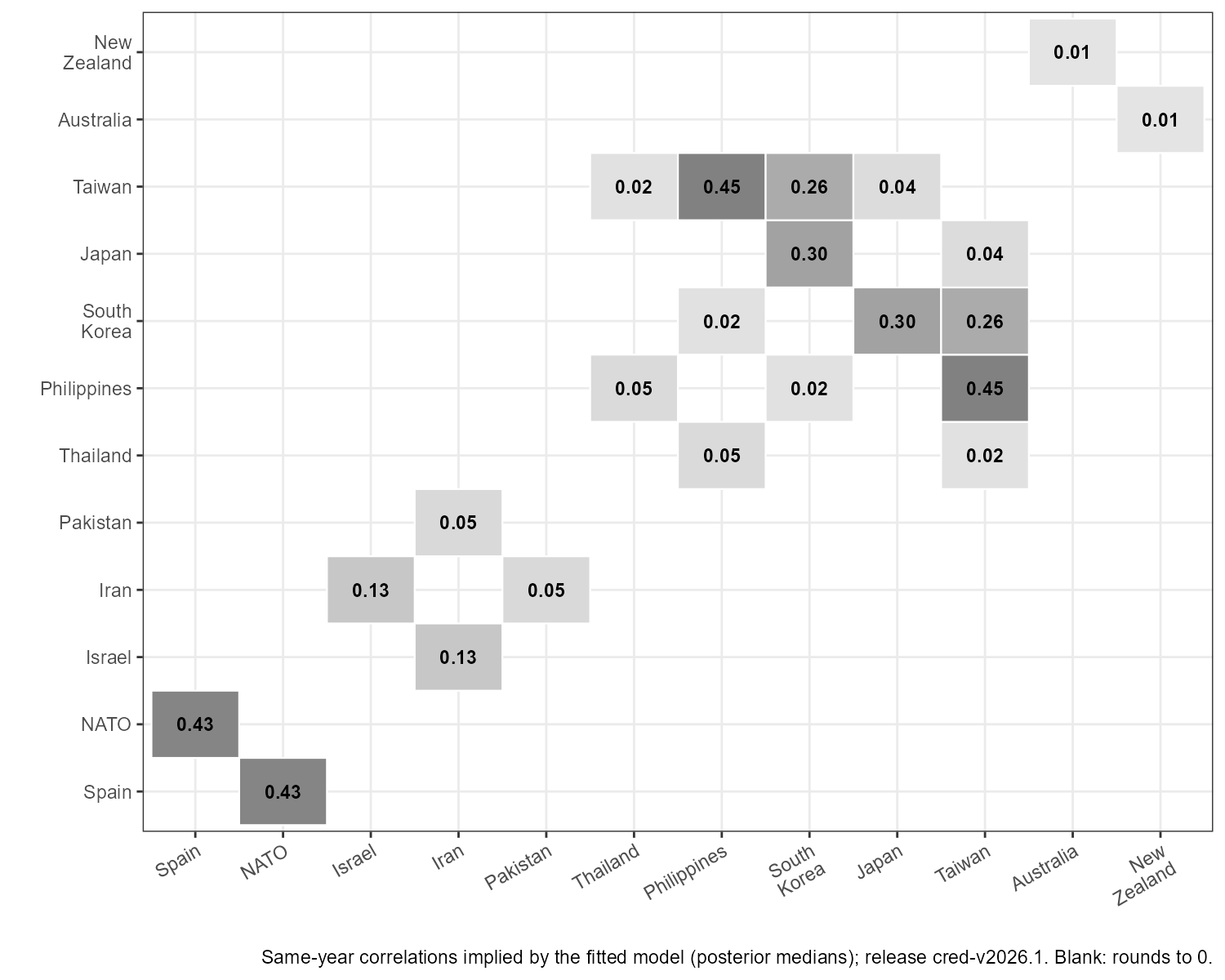
Credibility moves together in the same year only for allies close to each other geographically: Philippines–Taiwan (0.45), Spain–NATO (0.43), South Korea–Japan (0.30), South Korea–Taiwan (0.26) and Israel–Iran (0.13). Every other pair is 0.05 or below, so the average within a region is 0.12 and allies in different regions are uncorrelated.
What differs from the published analysis
- Measure. The released estimates (
irt_median), which combine expert and LLM ratings. The article used the expert survey alone. - Sample. The article’s 13 U.S. alliance partners.
- Model. An ordered beta regression with a bilateral-alliance indicator and a Gaussian process over location and year. Unlike the article, we compute an exact Gaussian process with one length-scale for distance on the map and another for time. The article used a single length-scale for both dimensions.
NoteThe result across releases
| Release | Fit | Same-year correlation, pairs in the same region | Same-year correlation, pairs in different regions |
|---|---|---|---|
| cred-v2026.1 | 2026-11-06 | 0.12 [0.06, 0.18] | 0.00 [0.00, 0.00] |
Posterior median [90% interval].
Downloads (release cred-v2026.1)
- correlations.csv: each pair’s same-year correlation: median and 90% interval
- matrix.png: the figure
- summary.json: the model, the fit and the headline numbers
- The data: Alley, Joshua, and Brian Blankenship. 2026. Alliance Credibility Data, release cred-v2026.1. Harvard Dataverse. https://doi.org/10.7910/DVN/HEFN8Z.
- The article: https://doi.org/10.1017/psrm.2026.10132